Approach

Approach
Story
“Havasu 402, contact Departure, 119.2.” “Phoenix Departure, Havasu 402, one thousand four hundred for three thousand.” “Havasu 402, turn left direct Buckeye, on course, climb and maintain eight thousand.” “Departure, Havasu 402, direct Buckeye, climb and maintain eight thousand.”
As I turned toward Buckeye VOR, the last rays of sun splintered above the mountains. I was the captain of a Navajo Chieftain, flying from Phoenix to Lake Havasu City, Arizona.
During the climb, Phoenix Departure handed me off.
“Havasu 402, Los Angeles Center, maintain eight thousand feet. Be advised, winds of forty knots have been reported at eight thousand feet over Needles VOR.” “Havasu 402, maintain eight thousand. Thank you for the wind report.”
I had checked the forecast earlier at Sky Harbor: two miles visibility, winds up to thirty‑five knots. The report confirmed it.
I glanced back at my eight passengers. Some were asleep; others watched the last light fade. Because of the weather at Lake Havasu, an instrument approach was required for arrival.
I anticipated the VOR approach to runway 14, followed by a circling maneuver to land. The final approach course was not aligned with the runway; a turn would be required to align with the runway. The approach included a holding pattern over the VOR, with a descent once established inbound.
The automated report included winds aloft: at eight thousand feet, wind 190 degrees at forty‑five knots, gusting to fifty‑five. The outbound leg of the published hold called for one minute. I extended it to one minute and thirty seconds. Mountains lay west of the VOR, and the additional distance provided the airspace needed to intercept the final approach course.
If alignment on the inbound course could not be established, I had a plan.
Approaching Needles VOR, I called Center.
“Los Angeles Center, Havasu 402, level at eight thousand, request VOR approach runway 14, circle to land.” “Havasu 402, cleared VOR 14 approach to Havasu, circle to land. How’s the ride?” “Havasu 402, cleared for the approach. Moderate.” “Havasu 402, thank you. Report final approach course inbound.”
One minute from the VOR, I selected fifteen degrees of flaps and slowed to 130 knots. I set the outbound course. The Chieftain had no autopilot. My hands maintained a light grip on the yoke.
Over the VOR, I initiated a right turn. I was above the clouds, black sky overhead. As the needle moved, I rolled wings level and intercepted the outbound course. Established, I began a descent to 6,200 feet and started the timer.
Clouds engulfed the airplane. Visibility dropped to zero. I relied on the instruments for navigation and orientation.
At one minute and thirty seconds, I began the turn inbound and dialed the final approach course into the HSI.
I rolled wings level on an intercept heading and slowed to 120 knots. After a few seconds, the course needle began to move rapidly. From the rate of movement, I knew an immediate correction was required.
I banked left to thirty degrees. The needle slowed, then stopped left of center. The wind had pushed me through the final approach course.
West of me were mountains.
I increased the angle of bank and increased pressure on the left rudder pedal. The needle began moving back toward the selected course. I initiated the rollout to capture the inbound. The needle centered during the rollout.
I continued the turn into the wind to maintain alignment. With the needle centered in the HSI, I rolled wings level.
The Horizontal Situation Indicator showed wings level.
My body told me something else. I felt as if I were rolling over.
The rapid sequence of turns had induced vertigo. Every physical sensation told me I was in a left turn. Every instinct demanded correction. Every sense except one: my vision.
I locked my vision on the artificial horizon and scanned the altimeter and VSI. The horizon showed wings level. The HSI confirmed we were established on course.
“Los Angeles Center, Havasu 402, final approach course inbound on the VOR 14.” “Havasu 402, report runway or missed approach.”
The controller’s calm voice contrasted sharply with the chaos inside me. The instruments showed on course, on altitude, on speed. My body told me a different story.
“Havasu 402, will report runway in sight or missed.”
The rolling sensation continued. Sweat gathered on my face. My body was convinced I was banking left and drifting.
Trust the instruments.
The instruments were the source of truth. My inner ear demanded I believe the lie it fostered.
Crossing the VOR, I extended the landing gear and began the descent to decision height. With no reference to the horizon, I depended on the instruments for guidance. The airplane remained wings level, on course, on speed, in a descent.
At decision height, we broke out of the clouds.
In an instant, my body aligned with reality. I took a breath, extended flaps to twenty‑five degrees, turned the airplane to align with the runway, and made a normal landing.
“Los Angeles Center, Havasu 402, runway in sight.”
No one else knew the effort it took to keep my attention fixed on the source of truth and refuse the lie. I was exhausted.
Reflection
The Artificial Horizon showed me reality and kept the aircraft safe.
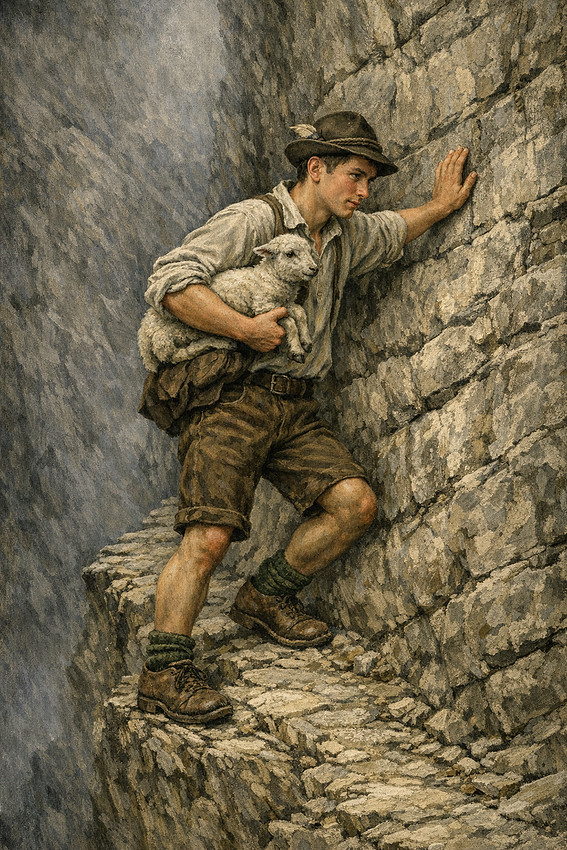
With the Lord as my Shepherd, I am safe.
Prayer
Read
Psalm 23:1–3
